
Can a pub, café or restaurant refuse service? What UK law allows
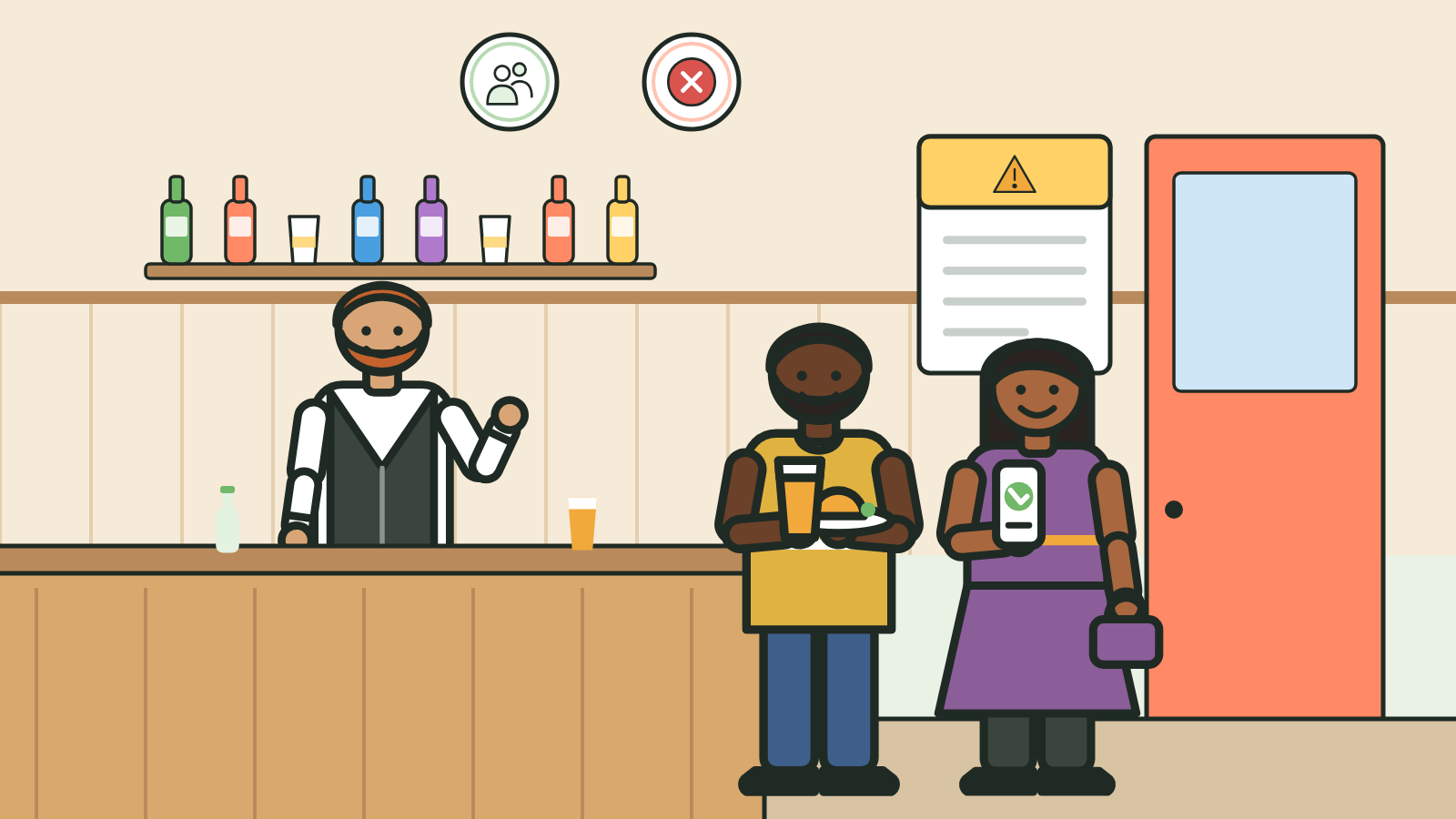
Yes, in a lot of situations. You can refuse service to someone who's abusive, threatening or breaking your house rules, and on licensed premises your staff must not knowingly serve alcohol to someone who's drunk. What the law rules out is refusing someone because of a protected characteristic, such as their race, a disability, their sex or their sexual orientation.
This covers England and Wales.
Is there a "right to refuse service" in UK law?
Not as a single rule. There's no law that lets a business refuse anyone for any reason. What the law does is set limits, and the two that matter most in hospitality are the Equality Act 2010 and the Licensing Act 2003.
So "we reserve the right to refuse service" on a sign by the door is a statement of your own policy. It's fine to have, and it doesn't override either Act.
What you can't refuse service for
Section 29 of the Equality Act 2010 says a business providing a service to the public "must not discriminate against a person requiring the service by not providing the person with the service". It also covers serving someone on worse terms, or stopping serving them partway through.
For customers, the protected characteristics are age (for adults), disability, gender reassignment, pregnancy and maternity (which includes breastfeeding), race, religion or belief, sex and sexual orientation, according to the EHRC's guidance. Marriage and civil partnership doesn't apply to services, and nor does age for under-18s (section 28).
The EHRC's guidance gives hospitality examples of what not to do. A café owner "must not ask a woman to leave their café because she is breastfeeding her baby". A pub can't refuse to serve someone because of gender reassignment. A bar that turns away someone with epilepsy because a seizure might disturb other customers is likely to be discriminating.
It also counts if staff refuse someone because of who they're with, such as a café that won't serve a customer because they have a disabled child with them.
Assistance dogs
A "no dogs" rule is common, but the EHRC's example is clear. Turning away a disabled person because their assistance dog is with them "would be discrimination arising from disability" unless the business can objectively justify it. A notice that says "no dogs, except assistance dogs" avoids the problem.
Barring someone after a complaint
If a customer complains that they were discriminated against and you then bar them, that's likely to be victimisation. The EHRC's example is a café that bars a woman after she complained about being told to breastfeed in the toilets.
What you can refuse service for
Behaviour
The EHRC says a business "can still tell customers what standards of behaviour they want from them", for example behaving with respect towards staff and other customers. Shouting at the bar staff, threatening another customer or wandering behind the bar are all things you can act on.
There's one catch. If a behaviour rule affects people with a particular protected characteristic more than others, you need to be able to "objectively justify" it, and you must make reasonable adjustments for disabled people. The EHRC's example is a family in a café whose teenage daughter, who has a learning disability, laughs and talks loudly. Asking them to leave would be hard to justify unless she was causing real problems for staff or other customers.
Drunk customers
On licensed premises, knowingly selling alcohol to someone who's drunk, or allowing it to be sold, is an offence under section 141 of the Licensing Act 2003. It applies to anyone working there with authority to sell alcohol, the premises licence holder and the designated premises supervisor, and carries a fine of up to £1,000.
The customer's mate can't get round it either. Section 142 makes it an offence to knowingly buy alcohol for a drunk person to drink on the premises.
If a drunk or disorderly customer won't leave when staff ask, they commit an offence themselves under section 143, and the police must help remove them if you ask.
Under-18s and ID
Selling alcohol to anyone under 18 is an offence under section 146. A seller has a defence if they believed the customer was 18 or over and took all reasonable steps to check, which the Act describes as asking for evidence of age that would have convinced a reasonable person. The EHRC notes a business can refuse an age-restricted sale to someone who looks younger and can't prove their age, provided it has put up signs saying proof of age will be needed.
Refusing service to protect your staff
From 30 October 2026, an employer can be liable if a customer harasses a member of staff and the employer didn't take all reasonable steps to prevent it. One of the steps Acas suggests is "telling customers the consequences of harassing workers, for example on posters". The post on the harassment law changes on 30 October 2026 explains the new duty.
In practice that means deciding in advance what happens when someone crosses the line, and making sure everyone on shift knows. Say Dan Smith is on the bar on a Saturday when a customer keeps grabbing at a server as she passes. If the rule is already written down, he doesn't have to make it up on the spot. He knows he can stop serving, ask the customer to leave and write down what happened.
A sign helps
A notice by the door or the till sets out the standard before anyone breaks it. There's a free "we reserve the right to refuse service" sign maker in the free resources section of this site, with wording for abusive behaviour, drunk customers and assistance dogs. Your own wording stays within the law when it's about behaviour, not who someone is.
That's the general position, not legal advice. For a specific case, check the EHRC's guidance or ask your council's licensing team, and see Acas for the staff side.
Where managero fits
When something goes wrong in service, managero lets your team write it up as an incident on their phone, recorded with the time it happened rather than the time it was typed. Customer complaints can be logged too, so the record of what happened, and what you did about it, is there if anyone asks later.
Common questions
- Are you allowed to refuse service to rude customers?
- Yes. The EHRC's guidance says a business can tell customers what standards of behaviour it wants from them, such as behaving with respect towards staff and other customers. What you can't do is refuse someone because of a protected characteristic, or apply a behaviour rule that hits one group harder unless you can objectively justify it.
- Can pubs refuse to serve anyone?
- A pub can refuse service for reasons like abusive behaviour, and staff must refuse to sell alcohol to someone who's drunk: knowingly doing so is an offence under the Licensing Act 2003. The Equality Act 2010 rules out refusing someone because of a protected characteristic such as race, disability, sex or sexual orientation, so 'anyone, for any reason' isn't accurate.
- Can you choose not to serve a customer?
- Often, yes. No official source sets out a general right to refuse service, but the law limits it in two ways. You must not refuse because of a protected characteristic, under section 29 of the Equality Act 2010. And on licensed premises you must not knowingly sell alcohol to someone who's drunk, under section 141 of the Licensing Act.
Sources
- Equality Act 2010, s.29 (provision of services)
- Equality Act 2010, s.28 (age under 18 and marriage and civil partnership excluded from services)
- EHRC, Your rights to equality from businesses providing goods, facilities or services to the public (updated June 2015), pages 8 to 14 and 40 to 43
- Licensing Act 2003, s.141 (sale of alcohol to a person who is drunk)
- Licensing Act 2003, s.142 (obtaining alcohol for a person who is drunk)
- Licensing Act 2003, s.143 (failure to leave licensed premises)
- Licensing Act 2003, s.146 (sale of alcohol to children)
- Acas, Third party harassment (last updated 26 August 2026)
More from the blog
-
The harassment law changes on 30 October 2026: what pubs, cafés and restaurants need to do
From 30 October 2026 employers must take all reasonable steps to prevent sexual harassment, and customers count. What it means for pubs and cafés. -
New employment laws: what they mean for restaurants, cafés and pubs
Sick pay from day one, 6-month claim limits and a stronger harassment duty from 30 October 2026: what the Employment Rights Act 2025 means for hospitality. -
Fridge, freezer and hot holding temperatures: the legal limits for UK food businesses
The legal fridge temperature in England and Wales is 8°C or below, hot food 63°C or above. What the law says, what's guidance, and what to check each day.